
Home Nurse vs Caregiver: What's the Difference & Who Does Your Loved One Need?
Not sure whether to hire a home nurse or caregiver in Gurgaon? Understand their responsibilities, qualifications, daily care duties and medical limitations before making a decision for your family.
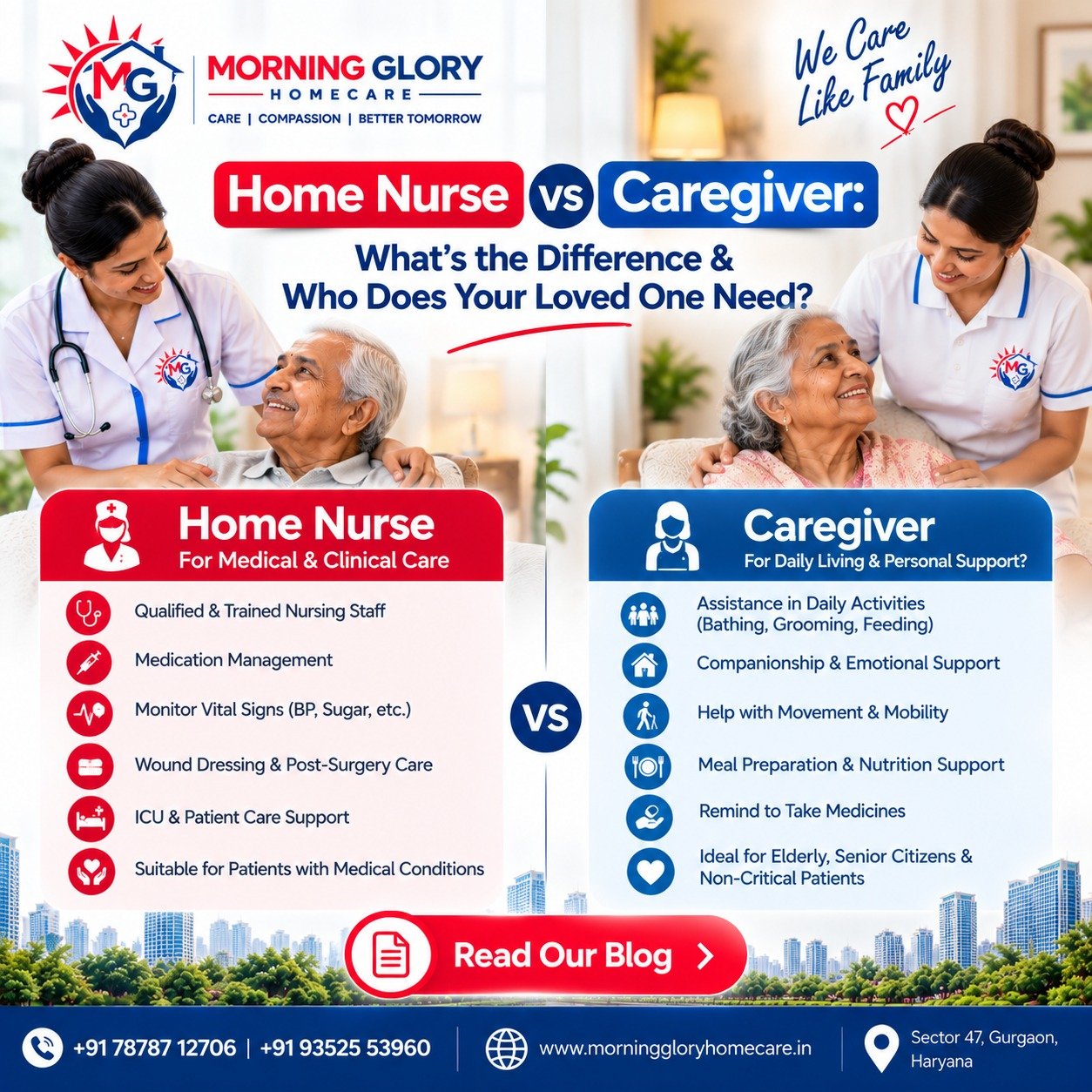
Quick answer: Choose a home nurse when your loved one requires clinical nursing care such as prescribed injections, wound dressings, medication administration or professional monitoring. Choose a caregiver when the main need is support with bathing, dressing, meals, mobility, toileting, reminders and companionship. Some patients benefit from both; the final plan should follow the treating clinician's advice.
1. What Is the Difference Between a Home Nurse and a Caregiver?
When a parent is discharged from hospital, a grandparent starts needing help with daily routines or a family member develops a long-term condition, relatives often search for a home nurse near me or caregiver at home in Gurgaon. The terms are sometimes used together in advertisements, but the underlying services are not identical.
A home nurse is a nursing professional whose clinical duties depend on their recognised qualifications, competence, applicable regulations and the doctor's care plan. Nursing work can include assessment, clinical observations, prescribed medicines or injections, wound management and identifying changes that should be escalated to a doctor.
A caregiver, patient attendant or caretaker usually assists with activities of daily living, often called ADLs. These include personal hygiene, dressing, transfers, eating and using the toilet. A caregiver may also provide companionship, help maintain routines and remind an individual about their medicine schedule, but a reminder is not the same as assessing, prescribing or administering treatment.
Home Nurse
Main focus: Skilled clinical and nursing support based on a medical care plan.
Example: A person who needs a prescribed injection and professional wound assessment.
Caregiver
Main focus: Personal assistance, safety, comfort and everyday living.
Example: An older adult needing help with bathing, meals, walking and company.
The roles can overlap in observation, comfort and communication, but a caregiver should never automatically be treated as a substitute for a qualified nurse. Different agencies may use job titles differently, so ask for the individual's actual training, credentials and written scope of work.
2. What Does a Home Nurse Do?
Home nursing services in Gurgaon are intended for patients with nursing needs that are more complex than routine personal assistance. The precise tasks must be approved by the treating healthcare professional and undertaken only by appropriately qualified staff.
Prescribed medication and injection support
A qualified nurse may administer prescribed medication or injections according to the written order, professional scope and safety protocols. Families should share the current prescription, allergies, medicine list and relevant discharge papers. No nurse or caregiver should independently change a medicine dose or treatment plan.
Wound dressing and infection observations
Following surgery or an injury, professional nursing support may be required for ordered wound dressings, assessment of wound appearance and timely escalation of warning signs such as increasing redness, discharge, fever or worsening pain. Dressings and procedures should follow medical instructions.
Vital-sign monitoring and documentation
Depending on the care plan, nursing staff may measure and record blood pressure, pulse, oxygen saturation, temperature and blood glucose. Readings must be interpreted in the context of the patient's condition, with concerning changes reported promptly to the treating clinician.
Post-operative and hospital-discharge care
After hospital discharge, a patient might require dressing changes, medicine administration, observation of clinical symptoms and coordination with the treating doctor. Family members should ask for a discharge summary that explains which tasks require a nurse and which can safely be supported by a caregiver.
Complex or critical-care support
Some medically stable patients with significant nursing needs may receive carefully planned care at home. Equipment support or ICU setup at home in Gurgaon must only be considered with the treating team's approval, appropriate staffing, equipment, emergency arrangements and monitoring. An unstable patient needs urgent medical assessment, not routine homecare booking.
Education and care coordination
Another part of nursing is explaining prescribed care to the patient or family, documenting care delivered, observing trends and communicating with doctors and caregivers. Clear handover notes help families avoid confusion during shift changes.
Safety boundary: An unqualified attendant must not be asked to carry out injections, IV therapy, invasive procedures, clinical wound assessment or other restricted tasks simply because a family member requests them. Scope and supervision must always be verified.
3. What Does a Caregiver Do at Home?
A professional caregiver or caretaker in Gurgaon primarily supports independence, dignity, comfort and practical day-to-day needs. Caregivers are valuable for older adults living alone, individuals with reduced mobility and patients who need regular assistance during recovery.
Bathing, dressing and personal hygiene
Caregivers can assist with washing, grooming, clothing changes, toileting and changing bedding or incontinence supplies where trained to do so. Respect for privacy, consent and a person's preferences is essential, especially when intimate care is involved.
Meal assistance and hydration reminders
Support might include serving food, preparing routine meals where included in the job description, helping someone eat and encouraging fluids according to their care plan. A patient with swallowing difficulties or a medically prescribed diet needs direction from qualified professionals before assistance is given.
Walking, transfers and fall prevention
Caregivers may help with safe walking, use of mobility aids and movement between bed, chair and bathroom. The level of physical assistance should match the person's assessment, equipment and caregiver training. Unsafe lifting can injure both patient and caregiver.
Companionship and daily routines
Conversation, recreational activities, reminders about meals or appointments and help maintaining a predictable routine may support wellbeing. Emotional support is particularly useful for a senior who spends long periods alone, while medical or psychological concerns should be referred appropriately.
Medication reminders—not independent medical decisions
A caregiver may remind a capable person to take their prescribed medicines, subject to their agreed care plan. Any assistance beyond reminders must comply with training, supervision, consent and local requirements. Caregivers must not diagnose a problem, alter medication, give injections or independently decide whether a prescribed dose should be withheld.
Reporting changes early
Well-trained caregivers can communicate concerns such as reduced food intake, new confusion, unusual weakness or a fall. Reporting observations is useful, but it does not replace assessment by a nurse or physician. Explore related elder care services in Gurgaon for daily support options.
4. Home Nurse vs Caregiver: Comparison Table
The table below offers a practical starting point. Duties vary with the worker's qualifications, the employer's policies and the patient's doctor-approved care plan.
| Factor | Home Nurse | Caregiver / Attendant |
|---|---|---|
| Primary purpose | Clinical nursing needs | Daily living and personal care |
| Qualifications | Recognised nursing qualification and appropriate registration where required | Relevant caregiving training and verified practical competence |
| Medicines | May administer prescribed treatment within professional scope | Reminders and only authorised assistance within defined scope |
| Injections / IV procedures | Only when prescribed and qualified to perform them | Not part of ordinary caregiving duties |
| Wound care | Clinical assessment and prescribed dressings within scope | Personal hygiene and non-clinical assistance |
| Daily activities | May assist as part of the nursing care plan | Bathing, grooming, feeding, toileting and mobility support |
| Typical patient | Patients with clinical monitoring or treatment needs | Seniors and patients requiring routine daily support |
| Duration | Scheduled visits, shifts or longer care as assessed | Hourly, day, night or extended shifts as arranged |
| Selection criteria | Clinical needs, medical orders, credentials and experience | ADL needs, mobility needs, training and compatibility |
Important: An individual who has completed a short caregiver course is not automatically a licensed nurse. Ask what credential is held, who supervises the care and what will happen if the patient becomes unwell.
5. Home Nurse or Caregiver: Which One Should You Hire?
Start with the care tasks rather than a job title. The most useful question is: What help does my loved one require today, and which tasks must be performed by a qualified clinician? Here are common family situations.
After Surgery
If the doctor has ordered injections, dressing changes or clinical monitoring, a home nurse may be appropriate. Daily bathing, meal and walking assistance may be covered separately by a caregiver.
Older Parent Living Alone
For support with meals, hygiene, reminders and companionship, a caregiver may be the better fit. Recurrent falls, confusion or new symptoms should trigger clinical assessment.
Limited Mobility
A trained caregiver can assist with routine movement and personal care following a mobility or transfer assessment. Additional nursing support may be required for pressure wounds or other medical complications.
Complex Medical Condition
Where treatment involves clinical procedures, close observation or frequent medication changes, discuss an appropriate nursing plan with the treating clinician. A standard caregiver alone may not be sufficient.
A simple five-question decision checklist
- Is there a current doctor's order for a clinical procedure at home?
- Does the person primarily need help with dressing, eating, bathing, toileting or walking?
- Are there new or changing symptoms that require professional medical review?
- Does the family need short visits, a daytime shift, overnight supervision or a combination?
- What training, nursing credentials, supervision and backup will the provider supply?
If your answers include both clinical treatment and everyday assistance, ask for a combined care plan. Families seeking general recovery assistance can also review patient care services at home in Gurgaon.
6. Can You Hire a Home Nurse and Caregiver Together?
Yes. In some households, combining both roles gives clearer responsibility and more suitable support. For instance, a person discharged after major surgery might need a qualified nurse for doctor-ordered wound care and clinical assessment, while a trained caregiver helps with meals, bathing, mobility and companionship between nursing visits.
The care team should clarify who performs each task, who keeps daily records, whom the caregiver contacts if a problem develops and how the family will reach the treating doctor. For an elderly parent with a chronic condition, occasional nursing visits combined with daily caregiver support may be sufficient—but only after an individual assessment.
Example of role separation: The nurse completes a prescribed dressing and records relevant clinical observations. The caregiver supports meals and washing, follows safe mobility instructions and reports any new concerns. Neither worker changes the doctor's treatment plan independently.
For more specialised arrangements, see critical care support and injection services at home. Their suitability depends on clinical assessment and local availability.
7. How to Choose Safe Home Care in Gurgaon
Whether you are arranging home nursing services in Sector 47 Gurgaon, a caregiver for your parents or support after discharge, a careful hiring process matters more than promotional claims. Before finalising any homecare arrangement, ask the agency the following questions.
Define the care plan. Share the doctor's discharge summary, important diagnoses, current prescriptions, mobility limitations and expected schedule. Keep sensitive information private and share it only through appropriate channels.
Verify qualifications and identity. Check identification, relevant training and professional nursing registration where applicable. Ask whether staff have experience with comparable care needs.
Confirm exactly what is included. Request a written description of personal care tasks, clinical duties, exclusions, shift hours and supervision. Confirm that household chores are not assumed unless agreed.
Ask about backup and escalation. Understand replacement arrangements, whom to contact for concerns, the doctor's contact route and the procedure in a medical emergency.
Review charges and terms. Get a written quotation describing hours, any night-shift charges, consumables, travel fees, minimum booking periods, cancellation rules and payment terms.
Monitor quality after services begin. Seek the patient's feedback, check punctuality, review care notes where relevant and update the plan if health or mobility changes.
How much do home nurses and caregivers cost in Gurgaon?
Rates are not fixed across all patients or providers. Nursing fees may vary with clinical skills required, length of shift, complexity, frequency of visits and requested timing. Caregiver costs also vary according to hours, mobility needs, overnight assistance and training requirements. Equipment and medical consumables may be charged separately.
Rather than relying on an unverified advertised starting price, request a personalised quote based on the patient's current needs. You can call +91 78787 12706 or +91 93525 53960 for information about Morning Glory Homecare's available service arrangements.
When routine home care is not enough
Sudden chest pain, severe breathing difficulty, collapse, new one-sided weakness, uncontrolled bleeding or an abrupt major change in consciousness may indicate an emergency. Seek emergency medical help immediately instead of waiting for a routine nurse or caregiver visit. Home care arrangements should complement—not delay—urgent evaluation.
8. Frequently Asked Questions: Home Nurse vs Caregiver
1. Is a home nurse the same as a caregiver?
No. Home nursing involves clinical tasks performed by appropriately qualified nursing professionals within a care plan. Caregiving focuses on daily living, personal assistance and companionship.
2. Who is better for elderly care at home in Gurgaon?
The better option depends on the individual's needs. Choose daily caregiver support for bathing, meals and companionship; request nursing assessment when prescribed clinical care or monitoring is needed. Some older adults need both.
3. Can a caregiver give injections at home?
Ordinary caregiver duties do not include injections. Prescribed injections should only be administered by a person authorised, qualified and competent to do so under applicable rules and the patient's medical plan.
4. Can a caregiver remind my parent to take medicine?
Medication reminders may be included in a caregiver's agreed duties. Help with medicine administration is different and needs assessment, training and appropriate authorisation. A caregiver must not change doses or treatment.
5. Do I need a nurse after hospital discharge?
Not always. Review the discharge instructions. If they specify injections, clinical dressings, advanced monitoring or other skilled tasks, ask the treating team about nursing support. For routine personal help alone, a caregiver may be sufficient.
6. Can I hire both a nurse and caregiver for one patient?
Yes. A combined arrangement can separate clinical treatment from round-the-clock daily assistance. Agree on individual responsibilities, documentation and escalation routes before care begins.
7. Can a caregiver help a bedridden patient?
A trained caregiver may help with hygiene, feeding and comfort as allowed by the care plan. Bedridden patients also need assessment of skin, mobility, nutrition, pressure injury risk and medical needs; some tasks require nursing supervision.
8. Are home nurses available for night shifts in Gurgaon?
Homecare providers may offer scheduled, night or extended nursing shifts depending on staffing and clinical needs. Confirm actual availability, required qualifications, handover arrangements and shift charges before booking.
9. What qualifications should I check before hiring a home nurse?
Ask for recognised nursing education, professional registration where applicable, identity verification, relevant clinical experience and evidence of competence for the specific tasks prescribed.
10. Can a caregiver assist patients with dementia?
A caregiver trained in dementia support may help with predictable routines, reassurance, meals and safe daily activities. New agitation, wandering, swallowing problems or sudden confusion should be assessed by an appropriate health professional.
11. How is a patient attendant different from a nurse?
A patient attendant is generally responsible for non-clinical personal support. A nurse may provide skilled nursing procedures and clinical observation within professional scope. Always check duties and qualifications rather than relying on the job title alone.
12. Is home nursing more expensive than caregiver care?
Skilled nursing frequently has different pricing because of professional qualifications and clinical responsibilities, but actual charges depend on shifts, tasks and availability. Request written quotes for comparable service hours.
13. Does home nursing replace hospital treatment?
No. Home nursing is appropriate only when a clinician considers home management safe and the right staff and support are available. Emergencies and unstable conditions require timely hospital or emergency assessment.
14. How can I book home nurse or caregiver services in Sector 47 Gurgaon?
Contact Morning Glory Homecare at +91 78787 12706 or +91 93525 53960, describe the patient's needs and share relevant care instructions. Confirm suitability, scheduling, staff credentials and charges before booking.
Sources, Editorial Standards & Medical Disclaimer
About this guide: Prepared by the Morning Glory Homecare Editorial Team for general family education. It explains typical roles; it is not an individual medical assessment and does not create a claim that every listed procedure is available for every patient. Content should be reviewed and updated when relevant clinical guidance changes. No clinician review is claimed without a named, verified reviewer.
Further reading: NHS – Help at home from a paid carer; UCLH – Activities of Daily Living; and Marie Curie – Nursing and personal care at home. These are educational references, not statements of Indian professional licensing law.
Disclaimer: This article does not substitute for advice from a doctor or registered nurse. Procedures, medication administration and complex home care require appropriate prescriptions, competence and oversight. Call local emergency services for urgent symptoms.
Need a Home Nurse or Caregiver in Gurgaon?
Tell Morning Glory Homecare about your loved one's daily assistance needs, discharge instructions and preferred schedule. Ask which service and staffing arrangement is appropriate and available for your situation.
Unit No 716, 7th Floor, ILD Trade Centre Mall, Subhash Chowk, Sector 47, Gurgaon, Haryana 122018
View location on Google Maps →Also explore: Home Nursing · Elder Care · Patient Care · Morning Glory Homecare